1. CULTURAL ADVISOR: RESOURCES Responsibilities: ceremonies, celebration, story telling | 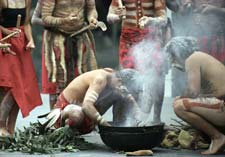 |
Take the time to view and explore the resources below suggested for your area of expertise. Don’t forget to put on your headphones as you may be listening to audio files or watching short videos. As you use each link, it might be helpful to reflect in your learning journal about key ideas or words you hear or see. Remember, you are going to use the information you gather to collaborate as a team to create a garden design. Refer back to the questions and issues listed under your area to help guide your research. The idea is for you to acknowledge and honour indigenous culture in some way …
Some questions and issues for you to consider when researching your area:
- What are some of the ways Aboriginal and/or Torres Strait Islander peoples perform ceremonies and celebrations?
- Are certain plants used by indigenous peoples to symbolise important issues or events?
- Are plants used as gifts?
- How is nature used in story telling (there are many significant Dreamtime stories to examine)?
- How is story telling used to communicate about the natural environment in indigenous cultures?
- How are Aboriginal and/or Torres Strait Islander peoples still using the natural environment? In a different or similar way compared to before European settlement?
- What sort of plants and design features would be important to include in your group’s design that would meet the needs to holding ceremonies or celebrations?
- What are some of the most significant or useful plants for this area of focus?
- Consider how you/we use or interact with nature for ceremonial or celebratory purposes.
- How do you feel about how much/how little you use or interact with nature for cultural reasons?
- Bunjilaka is the Aboriginal cultural centre at the Melbourne Museum. Explore the website to find out more about their indigenous garden (Milarri), gallery exhibitions and their space for traditional smoking ceremonies (Kalaya):
In particular, watch the video to find out more (on the right side of the screen):
- The significance of The Dreaming for Australian Indigenous people – from the Australian Government australia.gov.au website:
http://australia.gov.au/about-australia/australian-story/dreaming
- Australian indigenous ceremony (demonstrating the importance of song, music and dance) – from the Australian Government australia.gov.au website:
- This website provides information
on the significance of the Aboriginal and Torres Strait Islander Flags – from
the Australia Day Council of New South Wales:
- Useful explanations and information on the difference between a traditional Welcome to Country and Acknowledging Country – from ‘Creative Spirits’:
http://www.creativespirits.info/aboriginalculture/spirituality/welcome-to-country.html
- Take some time to explore Oscar’s Sketchbook (flash interactive) – an historical document from The National Museum of Australia depicting life in the 1800’s from an Aboriginal boy’s perspective:
http://www.nma.gov.au/collections/collection_interactives/oscars
- Read and watch the video about 2012 Senior Australian of the Year Laurie Baymarrwangga. She is a loved and respected leader of her people, the Yan-nhangu speaking Yolngu people of what is today known as the Crocodile Islands. Her cultural maintenance projects include the Crocodile Islands Rangers, a junior rangers group and an online Yan-nhangu dictionary for school children:
australianoftheyear.org.au/ recipients/?m=laurie- baymarrwangga-2012
- Explore the website of the Crocodile Island Rangers - view the videos and try using the dictionary. Can you find, listen to and try to pronounce Yan-nhangu words for mosquito, rainbow or butterfly?
- Aboriginal Trail Information on plant uses – from Australian National Botanic Gardens: This site will give you a lot of ideas about which plants might be suitable in your own garden design. Don’t forget to list both the botanical name and cultural uses:
http://www.anbg.gov.au/gardens/visiting/exploring/walks/aboriginal-trail/index.html
< Back
