FOR TEACHERS: i-Quest Title: FROM LITTLE THINGS BIG THINGS GROW Authors: Aurora Frattali and Clare Mathieson | 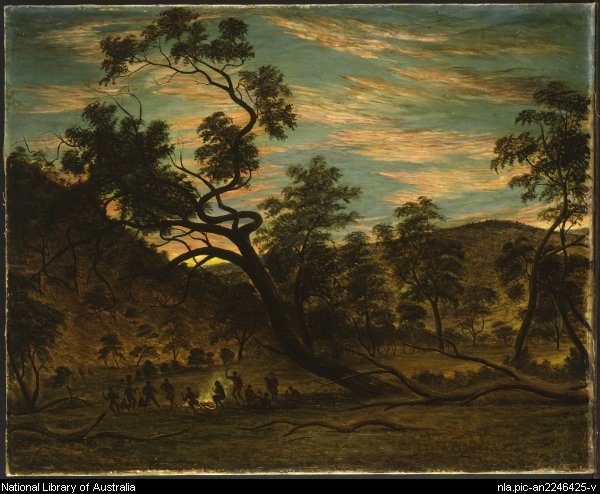 |
"Corroboree" by John Glover, 1940. Image courtesy of the National Library of Australia.
Level:
- Grade Level: Year 4 - It is recommended this be undertaken in the second half of the year to ensure prior knowledge and scaffolding has occurred
- VELS Level: 3
- Australian Curriculum: Year 4
Duration of integrated unit:
Approximately one school term (10 weeks)
Rationale:
Considering the Melbourne Declaration on Educational Goals for Young Australians and the cross-curriculum priorities of the Australian Curriculum, Aboriginal and Torres Strait Islander histories and cultures will be the key focus of the i-Quest. By understanding Australia’s history, its people, past and society, young people acquire learnings about their identities.
The title of the i-Quest was inspired by the Paul Kelly and Kev Carmody song, From Little Things Big Things Grow (and the book of the same title), written about land rights movement in Australia, telling the story of the proud Gurindji people and their stand against the might of the cattle baron, Lord Vesty. It is a story of hope and optimism obviously opens up much broader issues than what can be dealt within within this i-Quest, but felt it is important to acknowledge.
Intended Learning Aims and Desired Outcomes:
This i-Quest has been designed for students to develop a respect and understanding of Aboriginal and Torres Strait Islander peoples, and in particular, of the significance of the natural environment for these groups. Students will demonstrate these understandings through the design of a sustainable indigenous garden that respects indigenous cultures and traditions. The students will be exposed to ideas around traditions being continued and lost, and relate these ideas to their own lives.
The unit is aimed at providing real, connected, purposeful, challenging, authentic and meaningful learning experiences to lead to greater learning outcomes for all. The learning environment will be supportive and effective meaning that all students should be able to learn and grow.
Underpinned by desire to enrich students’ abilities to participate positively in the ongoing development of Australia, further learning outcomes of the i-Quest include:
- Develop an understand of why the natural environment was so important for Aboriginal and Torres Strait Islander peoples before European colonisation.
- Develop an understanding of the impact of colonisation on Aboriginal lifestyles in relation to the natural environment and consequently how Aboriginal peoples live today.
- Develop an understanding of how people can modify their environment to make the best use of what it has to offer, while at the same time maintaining the integrity of the land.
- Develop an appreciation for the sustainability achieved by Aboriginal cultures for thousands of years, enabling the land to be continually renewed and productive.
- Develop different perspectives on using the environment through comparisons and self-reflection.
- Deepen knowledge of Australia by engaging with the world’s oldest living culture.
- Develop a respectful understanding of social, historical and cultural contexts.
- Develop an appreciation and understanding of different community groups and traditions.
- Develop and recognise different points of view in regards to historical events.
Thinking Process and Skills:
To develop deep knowledge and understandings, this unit is designed to encourage children to move from exercising just lower-order thinking skills to higher-order processes including:
|
|
Australian Curriculum References:
Click here to view the relevant Australian Curriculum References for this i-Quest in PDF format.
Victorian Essential Learning Standards (VELS) References:
Click here to view the relevant VELS References for this i-Quest in PDF format.
i-Quest Planning Table:
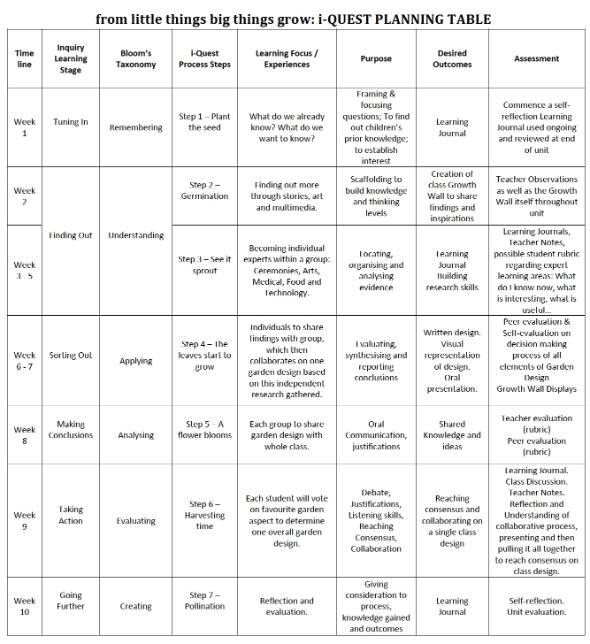
The i-Quest process has been linked to a plant growth process, which is connected to inquiry learning stages and Blooms Revised Taxonomy. A recommended timeline has been placed against each stage as a guide, but this is flexible, depending on how the students are progressing. Click here to open this planning table in PDF format or see below:
The Inquiry Model:
The design and planning for this i-Quest has been deeply informed and influenced by Kath Murdoch and David Hornsby's (1997) model of inquiry learning. It provided a systematic framework around which students’ progression and learning can be guided and scaffolded from initial engagement and tuning in to key concepts, right through to taking action.
Catering for Inclusion:
The learning experiences within the i-Quest aim to cater to a variety of learning styles with inclusion of activities that would appeal to:
- Bodily-kinaesthetic learners - opportunities to build 3D models
- Linguistic learners - share circles, oral presentations
- Spatial learners - imagery, videos, posters, use of the Growth Wall
- Logical-mathematical learners - by nature of the numeracy activities involving space and measurement
- Intrapersonal learners - independent activities
- Intrapersonal learners - group activities
- Naturalistic learners - by nature of the unit’s content
In addition, the combination of video, audio as well as written materials coupled with the various opportunities to present findings are aimed to enhance overall learning and engage students who are less confident readers or writers.
Scaffolding:
A variety of scaffolding strategies will be utilised throughout the i-Quest unit of work:
- The questions and prompts developed for Step 3 when the students take on an expert role (that builds the foundation knowledge for the rich task) is crucial in scaffolding students in engaging in deeper and broader thinking.
- The extensive list of resources available to each expert provides rich and useful information from which the students can judge the relevance and importance.
- Mixed ability grouping will allow for peer scaffolding of learning.
- Research and design elements will be scaffolded so that
- The i-Quest has been developed to promote an environment where substantive conversation occurs, in areas including critical reasoning (questioning, applying ideas), sharing ideas (that are not just teacher-driven) and the development of shared understandings stemming from student contributions. It is in this environment that opportunities for teacher and student scaffolding can occur.
Group Work:
It is at the teacher's discretion how to group students for this i-Quest (e.g. heterogenous, homogenous, social) to maximise learning outcomes for all students. The class should ideally be divided into groups of about 5 but if there are odd numbers then certain roles - with longer lists of links (like Art) can be shared, or with shorter lists could be combined. It is also at the teacher's discretion how the roles are allocated. This may be something that is left up to the students to negotiate so they practice these skills and take ownership of their own learning outcomes.
Prior Knowledge:
This unit of work has been designed based on the following prior knowledge (specifically related to Aboriginal and/or Torres Strait Islander peoples) acquired by students:
In accordance with the Australian Curriculum:
Year 4 History Focus - First Contacts:
The diversity and longevity of Australia’s first peoples and the ways Aboriginal and/or Torres Strait Islander Peoples are connected to Country and Place (land, sea, waterways and skies) and the implications for their daily lives.
Year 3 History Focus – Community and Remembrance:
The importance of Country and Place to Aboriginal and/or Torres Strait Islander peoples who belong to a local area.
In accordance with VELS Level 3:
Civics and Citizenship
As students work towards the achievement of Level 3 standards in Civics and Citizenship, they build on their understanding of Australian society and investigate some of the different cultural groups, including Aboriginal and Torres Strait Islander (ATSI) communities, that make up the Australian community. They learn about the contributions that people from diverse groups have made to many aspects of the Australian way of life. This includes contributions to the arts, industry, medicine and science, as well as to other aspects of their life including food, festivals and sporting events. They explore the ways that Australians are connected to other regional and global communities.
It is assumed students have prior experiences in teamwork, collaboration, negotiation, effective listening, presenting, and researching inquiry topics.
Habits of Mind:
The i-Quest encourages students to exercise the following Habits of Mind (thinking dispositions) in particular:
- Communicating with clarity and precision
- Creating, imagining, innovating
- Thinking interdependently
- Applying past knowledge to new situations
- Remaining open to continuous learnings
Classroom Set-up:
Growth Wall:
It is suggested that a ‘Growth Wall’ (like a wonder wall) be set up in the classroom. This is for the students to share any interesting findings, images or inspirations with the rest of the class over the 10-week unit. It should be decorated and themed by the students in line with the unit’s topics.
Artefacts Table/Corner:
Additionally, any interesting artefacts could be brought into the classroom by students, parents, teachers or community members to spark interest and tactile interactions. In particular, having indigenous plants for students to touch, smell and feel could enhance the learning experiences.
Excursion/Incursion Opportunities:
Possible Excursions:
- Royal Botanic Gardens Melbourne: Aboriginal Resources Trail
- Ceres Community Environment Park: Cultural (Aboriginal and Torres Strait Islander) and Sustainability Sessions
- LaTrobe Wildlife Sanctuary
- Melbourne Museum: Bunjilaka (Aboriginal Permanent Exhibition Space)
- National Gallery of Victoria: Permanent Aboriginal Art Space
Possible Incursions:
- Connect with local Aboriginal Communities and invite elders, artists, musicians and dancers to present and provide students with opportunities to deepen their engagement.
- LaTrobe Wildlife Sanctuary offers excellent liaison with final design and implementation of actual native garden designs including sourcing indigenous plants and nesting boxes.
- Invite local Aboriginal elders to speak to students about Country and other cultural practices.
- Engage with parents and school community members by sharing news of the unit of work in newsletters and bulletins and classroom blogs - they may offer support and resources that are both unique and unexpected.
Supporting and extending students’ learning:
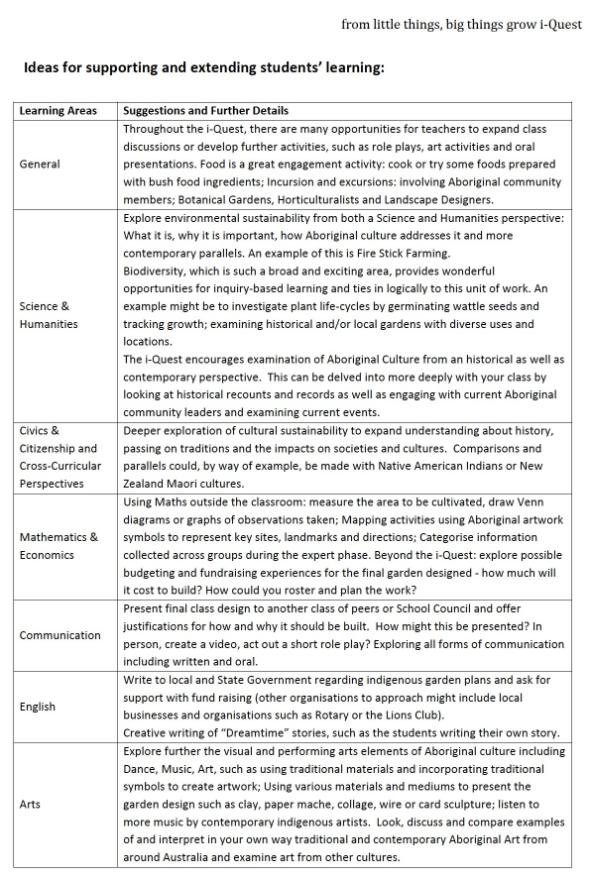
There are many ways student learning in this i-Quest can be further supported by whole classroom activities and where its themes can enrich day-to-day lessons. Here are some suggestions, which are by no means exhaustive, of the diversity and breadth of learning that can occur before, after and in parallel with this i-Quest (or click here for a printable version in PDF format):
Taking Action - Further Ideas:
We strongly support this i-Quest activity being in a real world context where students follow through to fruition of establishing an actual Indigenous Garden. Although beyond the scope of this i-Quest, we have made an attempt to offer some helpful hints and suggestions to get things started and encourage leadership, partnership and creativity from your class. Click here to view these ideas.
Lesson Details: Step 2 - Germination, Part b) Story Telling
Whole Class Activity Explanation:
One of the Finding Out experiences is the whole class activity detailed within Step 2 - Germination, Part b) Story Telling. This is an activity that adds tactile and human dimensions, which is why we felt it was meaningful and important to include (if time permits), so students can experience story telling for themselves rather than just reading a story - click here for the details required for the teacher to run this.
- Assessment as learning - the i-Quest provides many opportunities and learning experiences that allow students to self-reflect, peer-assess, take responsibility and enhance their own learning outcomes.
- Assessment for learning - a combination of observing students to monitor their progress, student feedback about the i-Quest, as well self-reflection by the teacher means that insights can be used to inform teaching (such as making slight adaptations to the i-Quest along the way and for future i-Quests or inquiry units).
- Assessment of learning - evaluation rubrics will be used at the end of the i-Quest to enable validation to students and the teacher that learning outcomes are (or are not) as they were intended and that teaching has been effective (or not).
Teacher Observations:
In addition to the evaluation rubrics listed on the Evaluating your growth page, it is recommended that the teacher undertake the following assessment and evaluation observation practices throughout the i-Quest:
- Monitor the Growth Wall - How are the students contributing to the wall and what sorts of things?
- Check learning journal entries - Are the students regularly self-reflecting? What sorts of learnings and insights are they recording?
- Listening and scaffolding during group work time - How are the individuals interacting and collaborating within the team? What listening and speaking skills are they demonstrating?
- Class discussions - How are different individuals contributing to class discussions?
Class Reflection (Discussion):
Although students will be provided feedback on the unit via a rubric, it is suggested an open class discussion occurs at the end of the unit. Using icy pole sticks that have reflection starters written on them, each child could pull a stick out to prompt and guide their reflection to the rest of the class.
See below for some ideas for the reflection starters (one starter per icy pole stick) or click here for a printable PDF version:
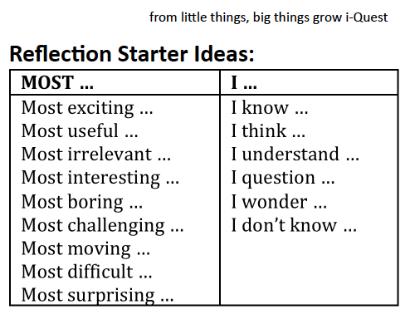
Adapted from Wilson, J. & Wing Jan, L. (2003) Focus on inquiry: a practical approach to integrated curriculum planning. Victoria: Curriculum Corporation.
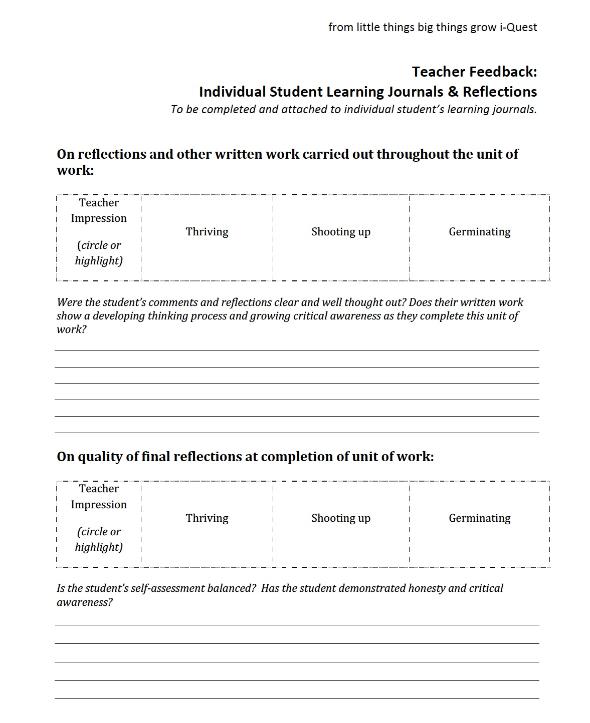
Evaluation of Student Reflections and Learning Journals:
It is recommended that teachers provide students with feedback on their reflections and learning journal entries to help students further develop skills in these areas (and to illustrate to them that
Click here for this evaluation form in PDF format or see below:
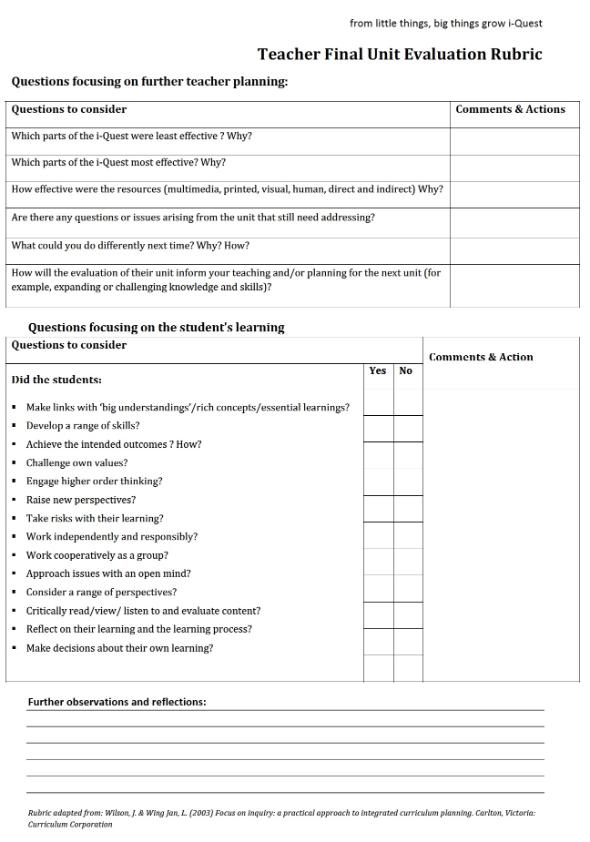
Teacher Evaluation of i-Quest:
To ensure the Assessment is used 'For Learning', it is also suggested that teachers complete the following unit evaluation rubric at the conclusion of the unit for self-reflection and future planning purposes (or click here for a printable version):
Technical Notes:
This i-Quest has links and resources from YouTube.com and other websites that may not be accessible at certain schools. Teachers are advised to speak with their school’s IT representative to provide the necessary temporary access if this is the case. It is advised that teachers view the resources prior to showing to students.
The i-Quest has been designed (and tested) to try and ensure optimal use on different types of computers and internet browsers by carefully selecting fonts and images. Unfortunately, unavoidable or unforeseen technical errors can still occur. To try and overcome this, all of the key teaching tools and resources have been included on the Teacher Resources page (scroll to the bottom of the page and click on the relevant file name).
Terminology:
Native vs Indigenous:
A brief note regarding the terms Native and Indigenous and their use in this i-Quest:
You may or may not be aware of the horticultural difference between these two terms. Strictly speaking, an Indigenous Garden is one made solely of native plants that grow and occur naturally in the geographical area of the garden. A Native Garden is a broader term referring to a garden planted with plants found throughout the country. Whilst we encourage the use of correct terminology, in the case of this i-Quest, we felt it more appropriate to use the term Indigenous Garden as we are focusing on Australian Aboriginal/Indigenous Cultural practices and awareness.
Australian Aboriginal Terminology:
Koorie: The term is used by the aboriginal people of Victoria, parts of New South Wales and Tasmania, describing the indigenous people's own word for themselves. It was originally a word from the North-Coast of New South Wales, recorded for the first time in 1834
Other names used by Australian Aboriginal people:
There are a number of other names from Australian Aboriginal languages commonly used to identify groups based on geography:
- Anangu in northern South Australia, and neighbouring parts of Western Australia and Northern Territory
- Bama in northern Queensland
- Murri in southern Queensland
- Nunga in southern South Australia
- Nyoongar in southern Western Australia
- Palawah (or Pallawah) in Tasmania.
- Wangai in central Western Australia
- Yolngu in Arnhem Land, Northern Territory
- Source: http://en.wikipedia.org/wiki/Koori Downloaded 28/3/2012
Click here for the Teacher References and Resources used in this i-Quest.
Next >
