STEP 2 - GERMINATION
(Germination = when a plant emerges from a seed)
Before we really get our hands dirty, let’s remind ourselves about what we already know and find out a little bit more about Indigenous cultures and traditions.
Part a) Continuing Traditions:
It has been said that European settlement had a significant impact on Indigenous Australians. Their strong connection with the land and their environment was threatened and their ways of life changed.
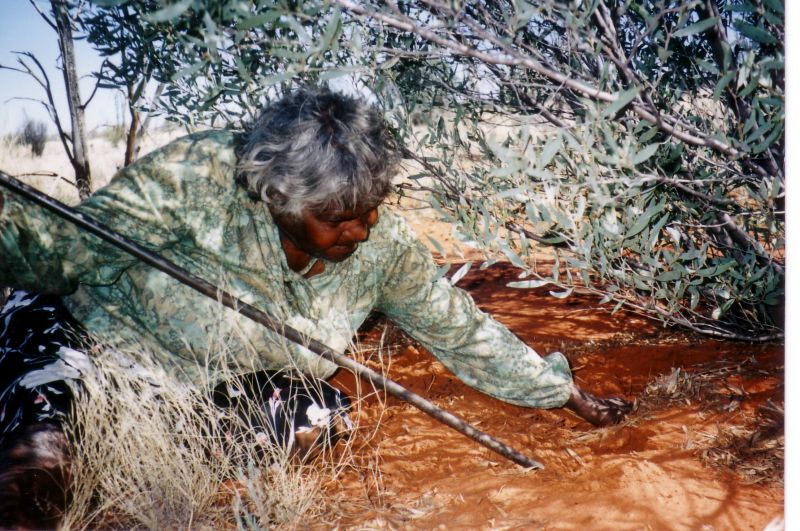
Many people living in Indigenous Australian communities today combine a modern life with traditional ways: they may buy food from a store, but also carry out the traditions of hunting and gathering food. They may drive a vehicle and use rifles and spears for hunting. Traditions such as song, dance, art and ceremony are also continued in many communities.
-> WATCH:
Click here to see how one community is mentoring young Indigenous people to help them continue their ancestors’ traditions. While you are watching the video, consider the following questions:
O
1) How are some of the ancient Indigenous traditions and knowledge being passed on to the young people?
2) Why was it important for the local Aboriginal community to ask for a tree to be removed?
3) Do you think it is important that these traditions and knowledge are passed on to future generations?
After watching the video, discuss these three questions as a whole class.
It’s time to self-reflect:
O
Thinking about your own family or culture, what are some traditions, knowledge, rituals that are passed on from generation to generation, or that you hope to pass on?
Ideas to get you thinking:- The way food is prepared and shared
- The way your family celebrates special events
- Is there something special you do with an elder in your family?
- Are there items that have been passed on from generation to generation, such as jewellery or watches?
- What might happen if your own traditions of sharing stories stopped? How would you feel?
-> WORD CLOUD:
Create a word cloud using wordle.net to present your thoughts and ideas about the questions above.
-> REFLECT:
Now, in your learning journal, in just a paragraph or so, reflect on why this notion of ‘passing things on’ or 'continuing traditions' is important to you. You can include a drawing to support your paragraph if you wish.
Part b) Story Telling
Today, many descendants of the First Australians continue their ancestors’ traditions. Through the tradition of storytelling, Indigenous Australian culture and customs are passed down through the generations. What if that no longer occurred?
Here are two examples of story telling to share culture, stories and traditions:
Watch the video of a Dreaming Story on how Tasmanian Tiger got its tail:
Songs are also a wonderful way traditional or important stories are passed on. Watch the video of the song "From Little Things Big Things Grow" by Paul Kelly and Kev Carmody (this is a beautiful song and was the inspiration for the title of this i-Quest).
-> CLASS ACTIVITY:
If there is time, participating in the activity below will be great fun and will encourage you to think about how knowledge and important information was passed from one generation to the next. This should be done as a whole class and will be guided by your teacher.
1. Gather your supplies:
The teacher will supply 4 pieces of fruit (e.g. apple, pear, banana and an orange), a vegetable knife and a cutting board.
2. Directions:
You are to all sit in a circle with the teacher.
The fruit will be placed in front of the student sitting to the immediate right of the teacher.
You should imagine that these are “strange and exotic fruit” that nobody has ever tasted before so they do not know whether they are good or bad to eat.
The teacher will whisper the instructions of how to prepare each of the fruits to the student on their immediate left.
This student then whispers to the person on their left and so on until it has passed all the way around the group to the student with the fruit.
3. Last student:
When the last student receives the whispered message, they must then prepare the food for eating, and you will see if the information has travelled around as it was first stared.
4. Whole class discussion:
Discuss what would happen if someone passed on the wrong information.
Now imagine if every person in the circle represented one generation. The person who gave them the message was their mother or father and the person they gave it to was their son or daughter.
Discuss where all the information is stored and what happens to it if an older person dies before passing their knowledge on.
What are some other methods of passing information from one person to another, without writing it down, or by telling someone by word of mouth? Examples may include artwork, dance, story or song. Working in your groups you could now try one of these other methods to pass on the message about food preparation to the class.
If you have extra time: With technology, computers and some pretty clever animation, Aboriginal Dreaming stories can be viewed and shared on the World Wide Web. Here’s link to more Aboriginal Dreaming Stories. If you have time (as a class or group) you may like to explore this website: http://www.abc.net.au/dustechoes/
Click here to move to Step 3.
